
Boxing
Weighted Agility-Ladder Drills for Boxing Footwork
Very light dumbbells can challenge posture during ladder drills, but clean boxing steps matter more than load or speed. Four patterns, clear limits, and the evidence behind them.
September 25, 2026
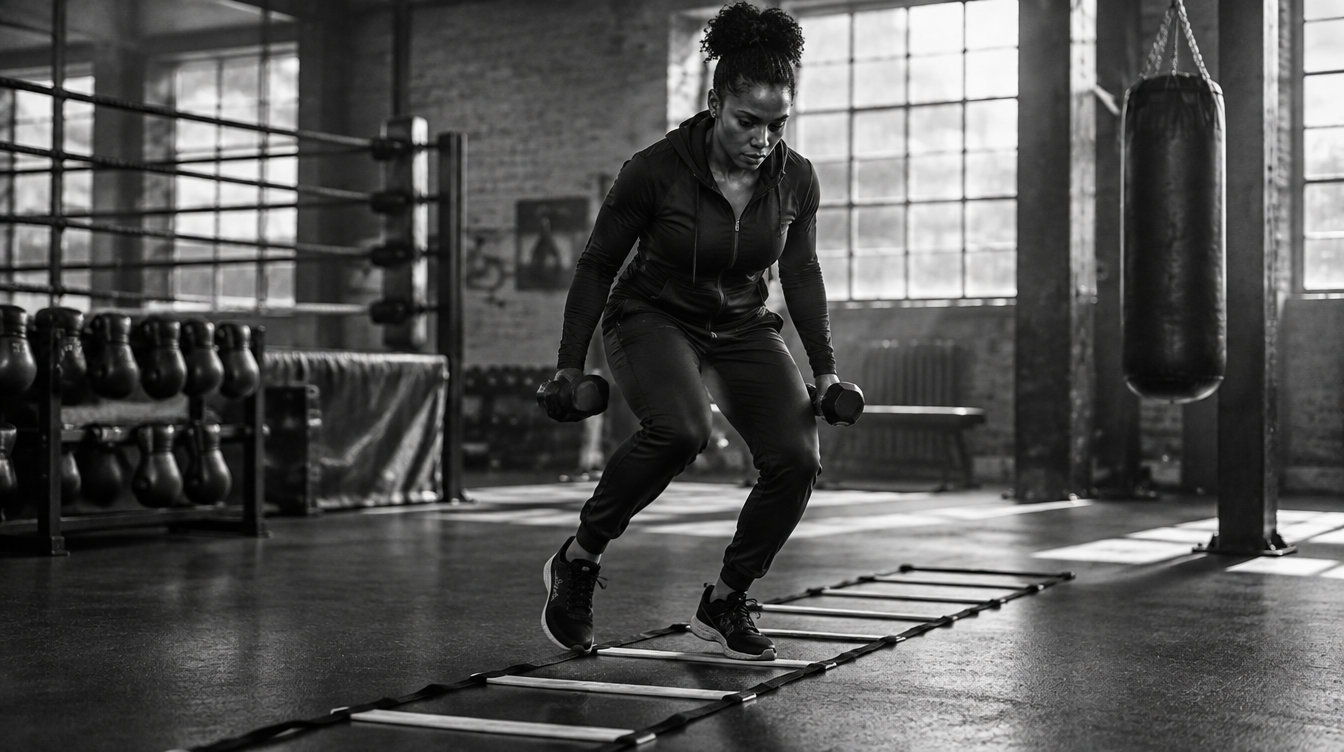
An agility ladder gives you a narrow problem to solve: move your feet through a pattern without losing your stance. Holding very light dumbbells adds another constraint. It does not turn the drill into strength work, and it does not make fast feet into good boxing footwork by itself. The point is to keep your hands, shoulders and trunk organized while your feet move.
Use weights only if the same pattern already looks clean without them. Think of the dumbbells as a posture check, not a challenge to lift heavier. A light object in each hand is enough to make an uncontrolled arm swing obvious. If holding them changes your steps, put them down.
What the ladder can and cannot teach
Boxing footwork is about arriving in a position from which you can move again. A quick step is not useful if your feet cross when they should not, your stance collapses, or your weight tips past your base. The ladder makes the location of each step visible; it cannot simulate an opponent, distance, timing or a real exchange.
Research does not justify calling ladder work a proven shortcut to better boxing. A systematic review found a small and mixed evidence base for agility-ladder training generally. One controlled youth soccer study found no clear advantage over normal training on several movement measures. Those are not boxing studies, and neither result says you cannot use a ladder to rehearse a specific pattern. It does mean you should judge the drill by how well the pattern carries into actual boxing practice, not by how fast you clear the rungs.
Research on added resistance in other sports also does not establish a benefit for holding dumbbells during boxing ladder drills. A karate warm-up study looked at vests and bands, not handheld weights on a ladder. Treat the combination here as a coaching constraint, not a proven performance intervention.
Set up before adding weight
Lay the ladder flat where it will not slide. Clear space beyond both ends. Wear footwear that lets you plant and turn without fighting the floor. Start at a walking pace with empty hands. Choose a stance you can reproduce: feet apart, knees soft, hands near your normal guard, and eyes looking ahead rather than glued to the next rung. Mark the ladder squares with tape if that is easier to read.
Pick the lightest pair of dumbbells you can hold comfortably without changing your arm position. There is no target weight, percentage, set count or race against a clock. If you cannot keep a relaxed grip, steady shoulders and controlled turns, the load is too much for this drill. Keep the bells close to your body; do not throw punches with them. Loaded shadowboxing asks a different question and can change the motion you are trying to practice.
Work through a short pass, reset your stance, then repeat if the movement still looks deliberate. Rest enough to make the next pass as precise as the first. Video from the front and side can reveal crossed feet and drifting shoulders better than the feeling of speed.
Drill 1: Step in, step out
Start in your boxing stance beside the first square, facing across the ladder. Step the lead foot into a square, follow with the rear foot while keeping space between your feet, then step the lead foot out on the far side and follow with the rear. Pause in stance before moving to the next square.
Think lead foot starts, rear foot restores the base. Do not bring your feet together merely to hit the marks. If the square is too small for your stance, use the outside edges of the ladder as guides instead of forcing both feet inside. First do this with no load. When you pick up the dumbbells, keep the hands quiet and notice whether your shoulders rise or your torso leans ahead of your feet.
Drill 2: Lateral step and gather
Face the length of the ladder in stance. Step sideways into the next square with the foot nearest the direction of travel; let the other foot follow enough to restore your normal spacing. Continue for a few squares, then turn around and work the opposite direction. Move at a pace that lets you finish every step balanced.
The goal is not to land both feet in every square. The square is a visual checkpoint for the lead foot. If your trailing foot clips the rung, shorten the travel or slow down. With the weights, keep your elbows near their ordinary guard position instead of swinging the bells to pull yourself sideways.
Drill 3: Advance, retreat, reset
Stand at one end with the ladder lengthwise in front of you. Step forward into the next space with the lead foot, then bring the rear foot forward to restore your stance. After two advances, retreat one space: rear foot moves first, lead foot follows. Continue only while you can tell which foot is initiating each direction.
This pattern is deliberately slower than a sprint through the ladder. Notice whether your feet get too close together during a reversal or whether you lean backward instead of moving the feet. If that happens, drop the load and rebuild the rhythm. The dumbbells should make your trunk position easier to observe, not make the direction change dramatic.
Drill 4: Step off and angle out
Begin alongside a square in stance. Take a small step into the marked space, gather your base, then step diagonally out to the side and pivot until your toes and torso point the same way. Settle briefly before returning to the next square. Practice angles on both sides, starting unweighted.
Do not plant one foot and wrench the rest of the body around it to finish the turn. Keep the pivot small enough that the whole movement stays controlled. You can put a strip of tape beside the ladder to mark a comfortable exit angle. The dumbbells stay close; they are not a reason to exaggerate a twist.
Make it useful beyond the squares
Run one or two unloaded passes after your weighted work. Then leave the ladder and repeat the same advance, retreat or angle step in open floor space. If the motion only works when you stare at marked squares, you have learned a ladder pattern, not necessarily better boxing movement.
Bring the steps into ordinary pad, bag or partner practice with appropriate supervision, without carrying dumbbells. Watch your distance and ability to reset after each move. Those conditions matter more than ladder speed. If a weighted pass becomes clumsy or you feel discomfort, stop the loaded version; a clear unloaded rep is better than a sloppy loaded one.
The takeaway is simple: use the ladder to expose foot-placement mistakes, and use very light dumbbells only to test whether your upper body stays organized. Neither tool replaces stance work against real movement. Clean steps win the drill.
Sources
- The Effects of Agility Ladders on Performance: A Systematic Reviewsystematic review
- Effects of Training with an Agility Ladder on Sprint, Agility, and Dribbling Performance in Youth Soccer Playerscontrolled study
- Effects of Warm-Ups with Weighted Vests and Resistance Bands on Physical Fitness and Combat Ability of Kumite Karate Athletesresearch study
Keep the feet honest. Build a repeatable practice before adding load.
Get drop access