
Gear
Cork vs. Rubber Yoga Mats: Grip, Weight, and Real Trade-Offs
Cork often grips better with moisture. Rubber usually feels tackier when dry. Construction, carry weight, and care matter just as much as the surface label.
September 25, 2026
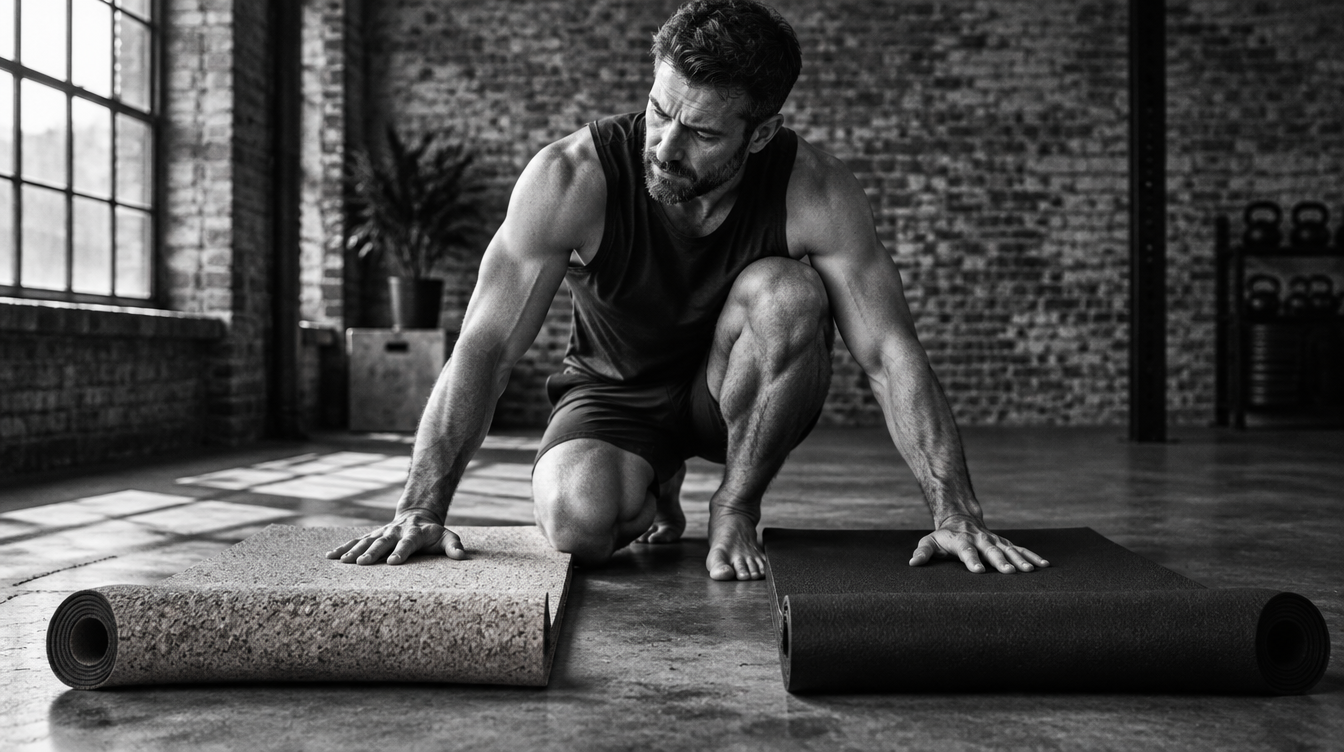
A yoga mat needs to work before you start sweating, during the hardest part of practice, and when you carry it home. Cork and rubber can handle those jobs differently. Neither material earns a blanket win.
The useful comparison is not “natural versus synthetic” or “premium versus basic.” It is dry traction, damp traction, underfoot feel, finished weight, and maintenance. Start there rather than with the packaging.
First, check what the mat is actually made of
A cork yoga mat is often a cork contact layer bonded to a backing, which may be natural rubber. That means “cork versus rubber” can really mean cork-topped rubber versus exposed rubber.
A product described as a rubber mat may also have another material on top. In that case, your hands are gripping the coating, not the rubber underneath.
Read the full construction description. Identify:
- The surface touching your hands and feet.
- The backing touching the floor.
- Any coatings or additional layers.
- The finished dimensions, thickness, and weight.
Those details prevent a common buying mistake: crediting the surface material for everything the complete mat does.
Grip: dry hands and sweaty hands ask different questions
Rubber usually has the stronger dry start
Exposed natural rubber commonly feels tackier than cork when dry. That can suit cooler rooms, shorter sessions, or practitioners whose palms stay relatively dry.
Cork generally feels firmer and less sticky at the start. That does not make it unusable for unheated yoga, but someone expecting immediate tack may find the difference noticeable.
These are tendencies, not performance ratings. The available comparisons are largely supplier guidance rather than standardized head-to-head testing. Surface finish, wear, cleaning residue, and your own hands can change the result.
Cork often improves with moisture
Cork surfaces commonly become grippier as they get damp. That makes them worth considering for sweaty practice. Some rubber surfaces become more slippery with sweat, but performance varies by product; “rubber” alone does not settle the question.
Do not translate “better with moisture” into “the wetter, the better.” A damp palm and standing sweat are different conditions. Check whether the manufacturer recommends lightly misting a cork surface before practice. Do not soak it to chase grip.
If your current mat slips only late in class, compare damp performance. If your hands drift during the opening poses, prioritize dry traction. Buying for the wrong part of the session leaves the original problem untouched.
Test without forcing the issue
Where a sample or return policy permits, try a short downward-facing dog and a standing lunge. Notice whether your palms creep, your feet rotate unexpectedly, or the whole mat moves against the floor.
Repeat after warming up naturally. There is no need to push deeper into a pose to prove a mat works. You are checking whether the contact feels predictable, not setting a traction record.
Weight and cushioning come from the whole build
Cork itself is lightweight. A finished cork mat with a substantial rubber base may not be. Check the listed weight rather than assuming a cork label means an easy commute.
Compare mats of similar length, width, and thickness. A thin travel mat and a full-size studio mat are different tools, even when their surfaces match.
For home practice, extra weight may be an acceptable trade for a dense, grounded feel. For a walk or transit journey, that same weight becomes something you carry alongside clothes and water. Picture the actual trip, not just the mat unrolled in a clean room.
Cork often feels firm at the contact surface. Rubber commonly offers a more resilient, cushioned feel, but thickness and backing matter substantially. Neither “thicker” nor “softer” automatically means better.
If you can test a mat, try a brief kneeling position and a standing balance. Does the floor feel too pronounced beneath you? Does the surface feel too yielding when you shift weight? Those answers are more useful than a generic comfort claim. Persistent pain belongs in a conversation with a qualified professional, not a material comparison.
Care: choose a routine you will actually do
The manufacturer's care instructions outrank a generic cleaning recipe, especially for bonded layers and coated surfaces.
Cork-topped mats
Use the recommended cleaning method and allow the mat to dry fully before storing it. Avoid assuming that cork's advertised antimicrobial properties make cleaning unnecessary. Sweat and visible dirt still need attention.
Check the rolling instructions too. Do not assume a cork-topped mat tolerates tight folding simply because a travel mat does.
Natural-rubber mats
Natural rubber needs protection from prolonged direct sunlight and heat. Use only cleaning products the manufacturer approves; a strong spray is not automatically a better cleaner.
Dry the mat before rolling and storing it. A parked car or sunny window is a poor default storage spot.
Natural rubber can also have a noticeable smell when new. If odor matters to you, inspect a sample or check the return terms. For latex allergy concerns, examine the complete construction—including a cork mat's backing—and ask the manufacturer and a qualified clinician rather than relying on the front label.
Takeaway: buy for your actual practice conditions
Start with exposed rubber if immediate dry tack is your priority. Put cork on the shortlist if your sessions get sweaty and you prefer a firmer, less sticky surface at the start.
Then compare finished weight, thickness, backing, and care requirements. If two mats look equally suitable, choose the one that performs predictably in your usual room and fits your transport and drying routine. A material reputation is less useful than a mat that works through the whole session.
Sources
- Cork vs Rubber Yoga Mat: Which One Fits Your Practiceweb / theyogasensei.com
- Are Cork Yoga Mats Better? A Guide to Your Best Practiceweb / huggermugger.com
- Natural Rubber vs Cork Yoga Mat: Which is Best for You? | Yoga Design Labweb / yogadesignlab.com
- Cork Yoga Mat vs Rubber Yoga Matweb / asivanayoga.com
- Is a Cork Yoga Mat Good? Benefits & Performance Reviewweb / huggermugger.com
Build a durable practice with gear that suits the way you actually train.
Get drop access